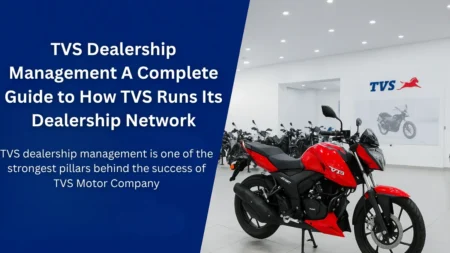
TVS dealership management is one of the strongest pillars behind the success of TVS Motor Company a brand trusted across India and the world for quality two-wheelers and three-wheelers. With thousands of outlets spread across cities, towns, and rural areas, TVS has built a dealership model that ensures efficiency, transparency, and customer satisfaction.
This article explains in detail how TVS manages its dealerships, how new dealers are selected, what systems are in place for performance monitoring, and how technology helps create a seamless customer experience.
What Is TVS Dealership Management?
TVS dealership management refers to the organized system through which TVS Motor Company controls, guides, and supports its network of dealerships. It includes all operational areas — from appointing new dealers and training staff to maintaining inventory, ensuring after-sales service, and monitoring customer feedback.
For TVS, dealerships are not just sales centers but also the brand’s face. Each dealer represents the company’s values — quality, trust, and commitment. That’s why TVS invests heavily in dealer development, customer experience, and technology to ensure uniform standards across its network.
Why Dealerships Are the Heart of TVS’s Success
The success of TVS Motor Company largely depends on its dealerships. Whether it’s a customer buying a TVS Apache, Jupiter, Raider, or Pep+, or someone coming for regular servicing — dealerships play a key role in building brand loyalty.
Through effective TVS dealership management, the company ensures that every dealership delivers consistent service quality, quick spare parts availability, and transparent communication. A satisfied customer is the best advertisement, and TVS understands that perfectly.
How TVS Selects and Approves New Dealerships
The process of becoming a TVS dealer involves multiple steps and careful evaluation. TVS prefers to work with partners who share its customer-first vision and ethical business practices. Here’s a look at the main stages of dealer selection:
- Market Analysis: The company studies the region’s population, vehicle demand, competition, and economic potential.
- Location Assessment: Dealers must have a showroom and workshop space that meet TVS’s layout and infrastructure standards.
- Financial Capacity: The applicant must have adequate financial strength to manage investment, inventory, and working capital.
- Experience: Prior experience in the automobile sector or retail business is an added advantage.
- Customer Service Orientation: TVS looks for entrepreneurs who value long-term customer relationships rather than short-term profits.
Once selected, dealers undergo a structured onboarding program, where TVS provides business training, operational guidance, and technical support.
Key Components of TVS Dealership Management
The TVS dealership management system focuses on six core areas that ensure smooth operation and customer satisfaction:
- Sales Management – Ensuring that each dealership meets monthly and yearly sales targets while maintaining fair pricing and transparency.
- Service Management – Every TVS service center follows strict quality protocols for vehicle repair, maintenance, and spare part replacement.
- Spare Parts Supply – TVS maintains a strong logistics network so that spare parts reach dealerships quickly and customers don’t face delays.
- Training & Development – Regular workshops and training sessions keep staff updated on new models, technologies, and customer handling techniques.
- Customer Relationship Management (CRM) – TVS uses digital CRM tools to track service records, complaints, and feedback to improve satisfaction.
- Performance Monitoring – Each dealership’s performance is evaluated monthly using KPIs (key performance indicators) like sales volume, service quality, and customer ratings.
Also read: Royal Enfield Classic 350 GST Rate in India: Complete Breakdown of Taxes and On-Road Price
The Role of Technology in TVS Dealership Management
TVS Motor Company has integrated advanced technology into its dealership management systems. The brand uses digital platforms for:
- Online Booking and Service Scheduling: Customers can book test drives, services, and even vehicles online.
- Dealer Management System (DMS): TVS’s DMS connects all dealers to the company’s central database, helping them track sales, stock, and customer interactions.
- Real-Time Analytics: Management teams can monitor dealership performance and market trends through data dashboards.
- Customer Feedback Apps: Feedback from customers helps improve service quality instantly.
By digitizing its dealership network, TVS ensures efficiency, transparency, and faster response to customer needs.
Training and Support for Dealers
A big part of TVS dealership management is dealer training. The company believes that well-trained staff are the key to customer satisfaction. TVS organizes:
- Product Knowledge Sessions: To help sales executives understand every detail of new models.
- Technical Training: For service engineers and technicians to ensure accurate diagnosis and repairs.
- Soft Skill Programs: To teach customer communication, problem-solving, and complaint resolution.
In addition, TVS provides marketing support, business planning assistance, and performance incentives to its dealers.
After-Sales Service – The Real Test of a Dealership
For TVS, after-sales service defines the real strength of a dealership. Customers judge a brand not just by its product but also by the service they receive afterward. TVS ensures that all its service centers maintain genuine spare parts, transparent billing, and trained technicians.
Dealers are encouraged to build long-term trust by offering service reminders, loyalty programs, and special offers. The company continuously monitors customer satisfaction scores (CSAT) and rewards high-performing dealerships.
Challenges in TVS Dealership Management
Like any large network, TVS also faces challenges in dealership management. These include:
- Maintaining consistency across different cities and rural markets
- Ensuring parts availability in remote areas
- Managing customer expectations in a competitive market
- Adapting quickly to changing technology and electric vehicle trends
To overcome these, TVS regularly upgrades its systems, improves supply chains, and launches digital tools that make operations smoother for dealers and customers alike.
The Future of TVS Dealership Management
As the automobile industry moves toward electrification and digital transformation, TVS dealership management is evolving too. The company is introducing eco-friendly practices, paperless processes, and connected service systems.
Electric scooters like the TVS iQube are bringing a new era of business opportunities for dealers. TVS is helping dealerships upgrade infrastructure to support EV charging, digital payment systems, and green operations.
In the future, TVS aims to create a fully digital, customer-centric dealership network that delivers fast, efficient, and enjoyable buying and service experiences.
Also read: Festival Offers on Bikes 2025: Best Deals, Discounts, and Benefits This Festive Season
conclusion
TVS dealership management is a model example of how an Indian automotive brand can successfully run a massive dealer network with discipline, technology, and a customer-first approach.
By combining traditional values of trust with modern systems of efficiency, TVS ensures that every customer — whether in a metro city or a small town experiences the same high-quality service.
Behind every TVS motorcycle or scooter on the road, there’s an entire system of people, processes, and passion working together — and that’s what makes TVS dealership management a true benchmark in the Indian automobile industry.